
Program Design 1: Building Quality from the Ground Up: A Systemic Approach to Online Degree Programs
This white paper examines how institutions can design sustainable, high-quality online degree programs through systemic program-level alignment rather than isolated course development. It presents a holistic framework built on four integrated pillars: Program Design, Teaching Support, Learner Support, and Learner Success. It demonstrates how these elements work together to create coherent student experiences from enrollment through graduation. The paper covers strategic curriculum alignment with institutional mission, collaborative faculty development models, embedded support systems that foster belonging, and comprehensive approaches to measuring student success beyond traditional metrics.
Dr. Amy Grincewicz draws on extensive research, including Quality Matters certification processes, Tinto's retention theory, and case studies from nursing and MBA programs to provide evidence-based strategies for building online learning ecosystems that serve diverse student populations while maintaining academic rigor and fostering meaningful community connections.
Program Design 2: Building Quality Through Alignment: Connecting Course Design to Program Outcomes
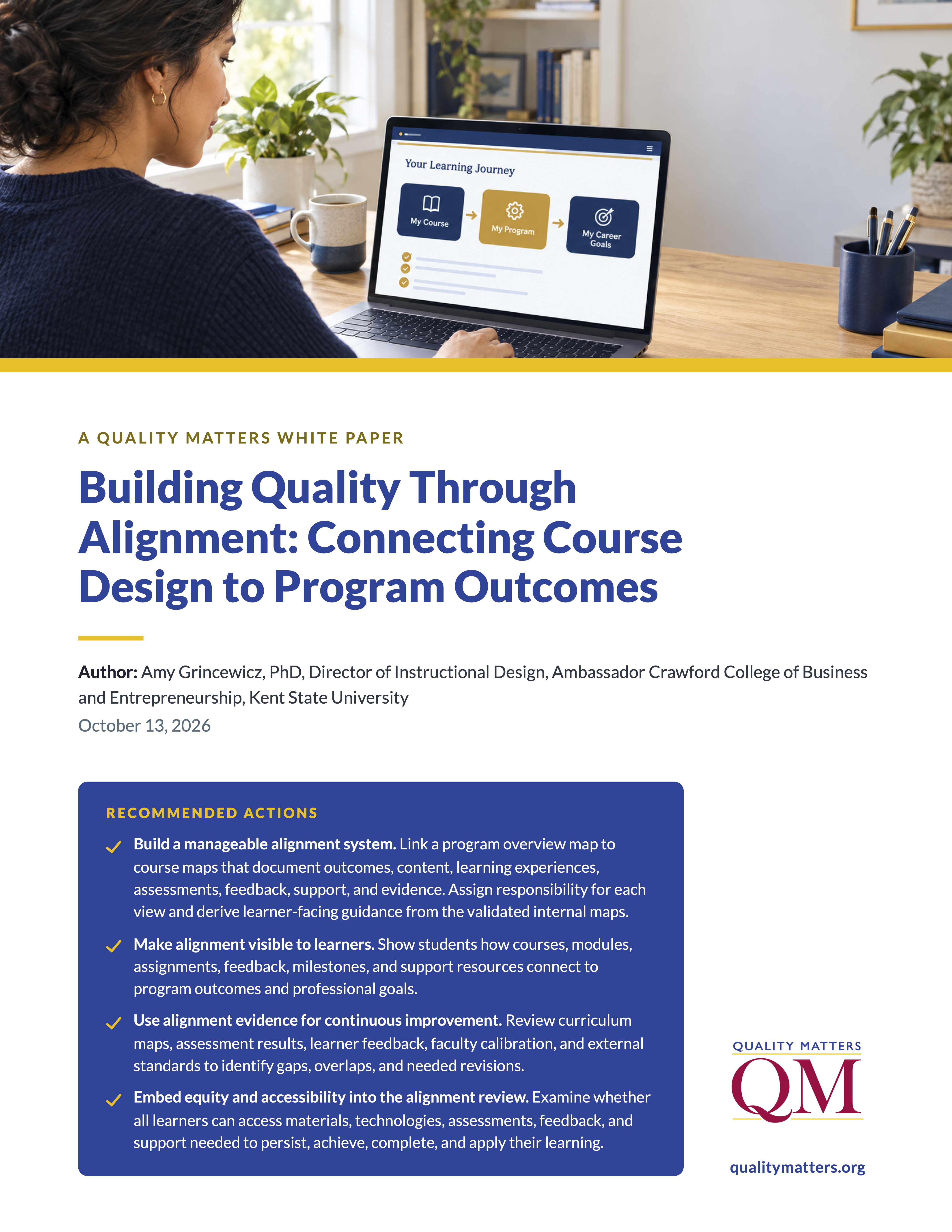
This white paper builds on the systems view of online program quality introduced in the first paper by examining how alignment connects individual program elements into a coherent learner experience. It explores how inconsistencies in navigation, expectations, feedback, support, and assessment can create barriers to learning, and how deliberate alignment can strengthen clarity, relevance, and progression across an online degree program.
Using the PALS conceptual model, the paper examines four connected dimensions: content alignment, learning experience alignment, assessment alignment, and continuous improvement. It considers whether content supports stated outcomes, learning experiences prepare students for the thinking and performance those outcomes require, assessments provide meaningful evidence of achievement, and programs use that evidence to guide improvement. It also examines alignment within courses and across the curriculum, emphasizing that students should experience an online degree program as a coherent pathway.
Dr. Amy Grincewicz draws on research in constructive alignment, curriculum mapping, cognitive progression, external review, and continuous evaluation to offer practical guidance for connecting course and program outcomes, defining and measuring learner success, and interpreting evidence over time. The paper emphasizes equity, faculty collaboration, shared responsibility, and sustained review as essential to an alignment system that supports learning and informs meaningful program improvement.
Join the author for a webinar on October 20, 2026 at 2:00 p.m. ET! Participants will learn how to use curricular alignment to connect learning activities, course outcomes, and program-level competencies in ways that strengthen student engagement, motivation, and progress toward degree completion.
About the Author

Dr. Amy M. Grincewicz is the Director of Instructional Design for the Ambassador Crawford College of Business and Entrepreneurship at Kent State University. She holds a Ph.D. in Instructional Design for Online Learning from Capella University, along with degrees in biology and mathematics. With more than 15 years of experience in online teaching and instructional design, Dr. Grincewicz specializes in eLearning, distance education, and brain-based learning. She is deeply involved with Quality Matters (QM) and holds many roles, including Senior Research Colleague. Her research and publications focus on online learning quality, learner engagement, and accessible, inclusive instructional design.
